
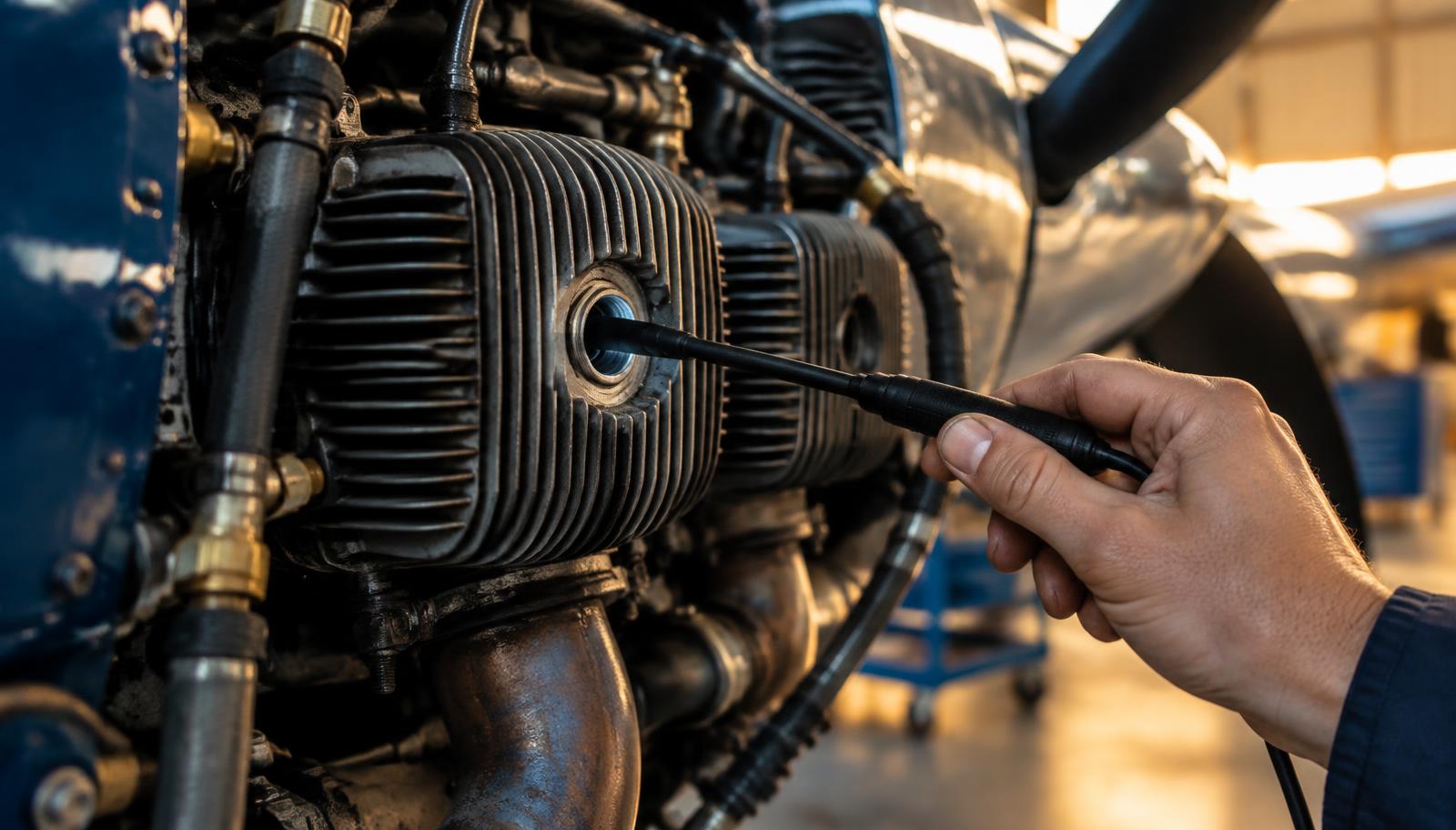
A rigid or flexible borescope fits through a spark plug hole and shows the valves, cylinder walls and piston crown of an assembled engine. The tool is cheap compared to a cylinder removal, but its real value appears only when the inspection is done the same way every time and the photos are kept with the aircraft records.
When a borescope inspection makes sense
- Low compression reading on the differential test, to find out whether it is a valve, a ring or the barrel before pulling anything.
- A pre-purchase inspection, where removing cylinders is not on the table.
- Trend monitoring between annuals on an engine that is flown regularly.
- After a suspected event: detonation, a stuck valve report, a long period of inactivity, or metal found in the oil filter.
- An aircraft returning to service after sitting, where corrosion on the cylinder walls is the main question.
Preparing the engine
- 1Let the engine cool completely. A hot cylinder distorts what the camera sees and is a burn hazard.
- 2Remove the top cowling and the top spark plugs — or the bottom plugs, depending on the access you need. Keep the plug leads and plugs organised by cylinder.
- 3Disable the ignition: verify the magneto switches are off, the mixture is in cut-off and the keys are out before anyone touches the propeller.
- 4Position the piston. For most photos you want the piston near bottom dead centre so the full barrel and both valves are visible. Move it only by hand on the propeller, following the engine manual.
How to take useful photos
The difference between a quick look and a record is consistency. Use the same sequence and angles for every cylinder, every time, and save the files.
- One overview photo of the whole chamber: both valves and the piston crown in frame.
- A close photo of each valve face and its seat area, intake and exhaust separately.
- Photos of the cylinder wall at several heights, rotating the scope to cover the full circumference.
- A photo of the piston crown.
- Any anomaly photographed twice: once in context, once close up.
- Label every file with aircraft, engine, cylinder number, date and engine time. A photo without a cylinder number is decoration, not a record.
What to look for
- Valves: edge burning, asymmetrical deposits, tulip distortion, cracks or a greenish tint on the exhaust valve face that can indicate leak paths.
- Valve seats: pitting, recession, or a contact pattern that no longer runs evenly around the seat.
- Cylinder walls: vertical scoring, rust pitting, glazing (a mirror-like shine), or areas where the honing crosshatch has disappeared.
- Piston crown: heavy or uneven deposits, erosion, impact marks or signs of detonation such as a sandblasted look on the crown edge.
- Deposits in general: their colour and distribution tell a story about mixture, oil control and how the engine is operated.
Keep the photos where the records live
- Attach the photos to the corresponding maintenance entry or work order, not to a phone gallery.
- Keep the same angles year after year so changes are visible at a glance.
- Record cylinder number, engine time and date with every set — future you, and any buyer's mechanic, will thank you.
Frequently asked questions
Can an owner perform a borescope inspection?
In the United States, the scope of what an owner may do is defined by the preventive maintenance rules. Looking inside a cylinder with a camera is commonly done by owners to understand their engine, but any maintenance decision or disassembly that follows belongs to a certificated mechanic. When in doubt, involve your mechanic from the start.
How often should cylinders be borescoped?
There is no universal interval. Many shops scope cylinders at every annual on higher-time engines, after long inactivity, or whenever a compression reading drops. What matters most is doing it consistently so trends are visible.
What does a burnt exhaust valve look like?
Typically an irregular, lighter-coloured or eroded area on the valve face edge, sometimes with deposits blown away from one spot. Early stages are subtle, which is why comparing photos from previous inspections is so valuable.
Is a borescope enough to approve a cylinder?
No. It is one piece of evidence alongside compression readings, oil analysis, filter inspection and operating history. Only a certificated mechanic can decide whether a cylinder stays, is repaired or is replaced.
More guides
Keep every due date in one place
Volamus tracks inspections, documents, discrepancies and costs for each aircraft and reminds you before anything lapses.