
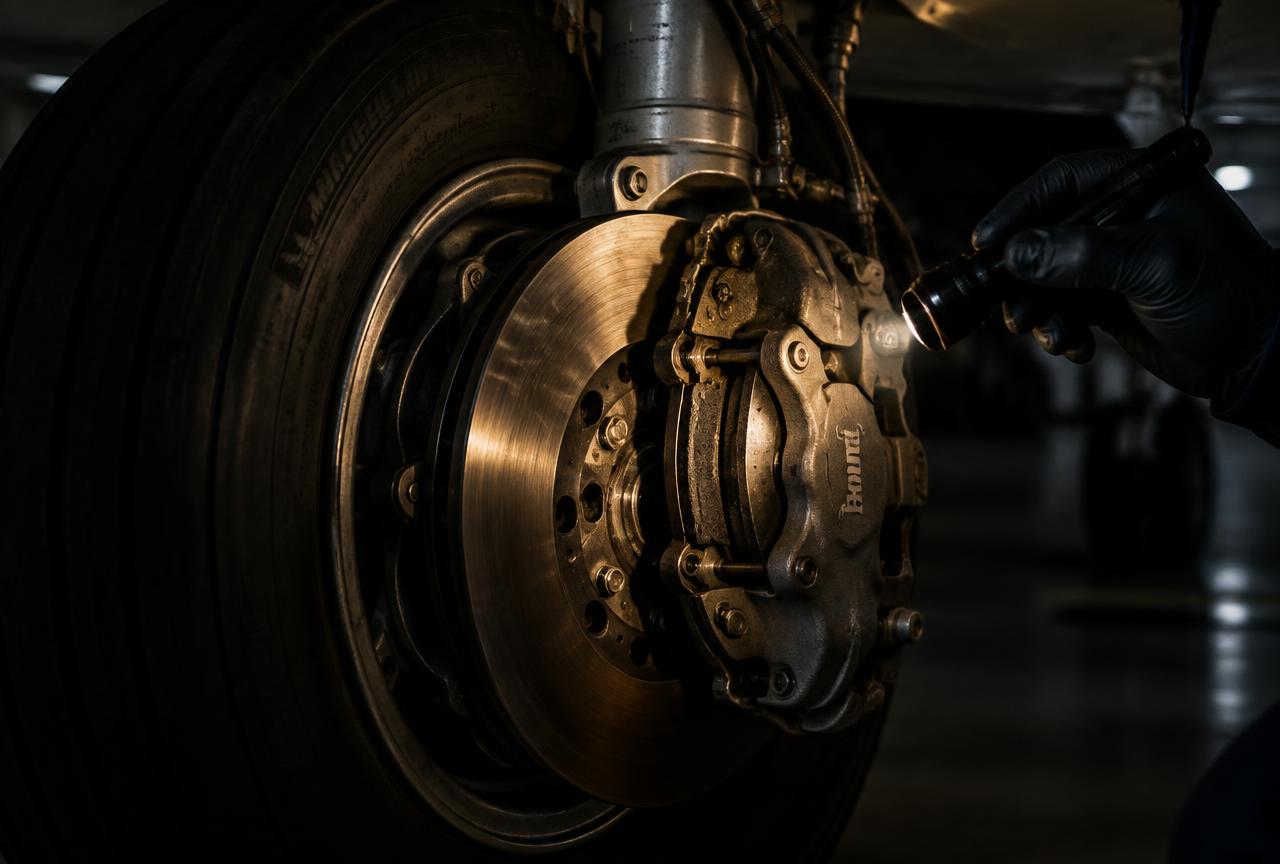
Brakes rarely fail all at once — they fade. Pads wear down to the backing plate, O-rings harden and begin to weep fluid, the pedal gets long and soft, and one day the landing roll is longer than you remember. The system is simple enough to inspect thoroughly at every oil service and annual, and cheap to fix when it is caught early. It is also one of the systems where “good enough for now” ends up costing the most.
How the system works
Most light aircraft use a simple hydraulic system: a master cylinder per side, tied to the toe pedals; rigid and flexible lines running out to the main gear; and a caliper that clamps a disc bolted to the wheel. The Cleveland-style system is the most common. What seals it all is a handful of rubber O-rings — in the master cylinder and in the caliper piston — and those little rings are exactly what ages.
- The master cylinder pushes fluid through the lines when you press the toe pedal; its piston is sealed by O-rings.
- The caliper contains a piston sealed by an O-ring; pressurised fluid pushes the piston and the pads clamp the disc.
- Aircraft with parking brake valves, dual (pilot/copilot) cylinders or toe brakes on both sides simply have more cylinders, more seals and more places to weep.
- Most light aircraft run MIL-PRF-5606 mineral hydraulic fluid; some types use a different fluid, and the two must never be mixed.
What an inspection covers
A brake inspection is methodical and quick, and it is a standard part of the annual and 100-hour inspection. This is what the mechanic works through — and what you can look at with them.
- 1Fluid level and type: the reservoir is checked at every service and topped up only with the fluid the aircraft manual specifies.
- 2Pads: the remaining lining is measured against the manufacturer's minimum thickness, and the pads are checked for fluid soaking, uneven wear and loose rivets.
- 3Disc: scoring, rust, heat discolouration, cracks and the minimum thickness marking.
- 4Leaks: wet fittings, staining running back along the line, damp marks inside the wheel fairing or on the tire, and a master cylinder that weeps at the pushrod boot.
- 5Pedal feel: a firm pedal is right; a spongy pedal means air or a leak; a pedal that slowly sinks under steady pressure means fluid is passing a seal.
- 6Lines and hoses: chafing, corrosion at fittings, cracked or bulging hose, and correct routing with the clamps intact.
Why new pads and new O-rings matter
- Worn pads: once the lining reaches its minimum, heat passes into the backing plate and the disc. Metal on metal ruins the disc, brakes poorly, and can lock the wheel.
- Fluid-soaked pads do not brake. They must be replaced and the leak fixed — and installing new pads over an unfixed leak ruins the new pads too.
- O-rings harden with age and heat. A hardened ring stops sealing and starts to weep — usually as a slow, invisible loss long before there is a puddle.
- Every time a master cylinder or caliper is opened, the O-rings are replaced. Reusing an old ring to save a few dollars is the classic cause of the leak that comes back.
- A slow leak also puts hydraulic fluid where it damages paint, fiberglass and tires — and where it can smoke against a hot disc after a long roll-out.
The signs a pilot can notice
The brake system announces most of its problems before they become dangerous. Write each one into the discrepancy log with the date, the hours and which wheel — the pattern is what the mechanic needs.
- 1The pedal feels spongy, or travels further than it used to before the brakes bite.
- 2With steady pressure, the pedal slowly sinks toward the floor.
- 3You need more pedal, or a longer roll, to stop the way you used to.
- 4A smell of hydraulic fluid after flight, or a dark damp stain inside the wheel fairing or on the tire sidewall.
- 5A brake that grabs, pulses or drags after landing — a sticking piston or a damaged disc.
Getting it fixed right
- Pads are replaced as a complete set for the wheel — both sides, and in pairs left and right so braking stays even.
- Whenever a master cylinder or caliper is opened, new O-rings go in, lubricated with the correct fluid — never installed dry, never with anything else.
- Fittings are torqued, the system is bled of air, and the pedal is checked firm before the aircraft flies.
- The shop checks for leaks at pressure — with the wheel off and the fittings visible — before the fairing goes back on.
- Discs that are deeply scored, corroded beyond limits or under minimum thickness are replaced or machined per the manufacturer's manual.
Keeping the record so it counts
Brake work is exactly the kind of work that disappears from memory and matters at the next annual, at the next 100-hour, and when you sell the aircraft. The record is what turns “we did the brakes recently” into evidence.
- The maintenance record entry: date, tach or hobbs hours, what was replaced (pads, O-rings, fluid, disc), part numbers, and the signature and certificate number of the mechanic.
- The shop invoice and any findings report, scanned and stored with the aircraft documents.
- The hours at which the pads were last replaced, so the next interval can be planned instead of discovered.
- Photos of the caliper with the new pads and O-rings — cheap proof, years later, of what was actually done.
Frequently asked questions
Can I replace my own brake pads?
In the United States, no — brake work is not on the preventive-maintenance list for private owners under 14 CFR Part 43, Appendix A(c). It is work for a certificated mechanic. Rules differ elsewhere; ask your maintenance organisation what applies to you.
Why does my brake pedal feel spongy?
Almost always air in the system, or fluid passing a worn O-ring. Air compresses; worn seals leak. Both have to be found and fixed by the shop before the system is trusted again.
How often should O-rings be replaced?
Every time a master cylinder or caliper is opened, and whenever inspection shows hardening, flattening or nicks. They cost very little; the leak they prevent costs much more.
Can I mix brake fluids?
No. Most light aircraft use MIL-PRF-5606 mineral fluid; other fluid types attack and swell the seals, and a system that received the wrong fluid must be completely flushed. Use only what the aircraft manual specifies.
There is a fluid stain inside my wheel fairing. Is it urgent?
Treat it as an active leak and have it inspected before the next flight. Small weeps have a way of becoming empty systems on a landing roll-out.
More guides
Keep every due date in one place
Volamus tracks inspections, documents, discrepancies and costs for each aircraft and reminds you before anything lapses.