
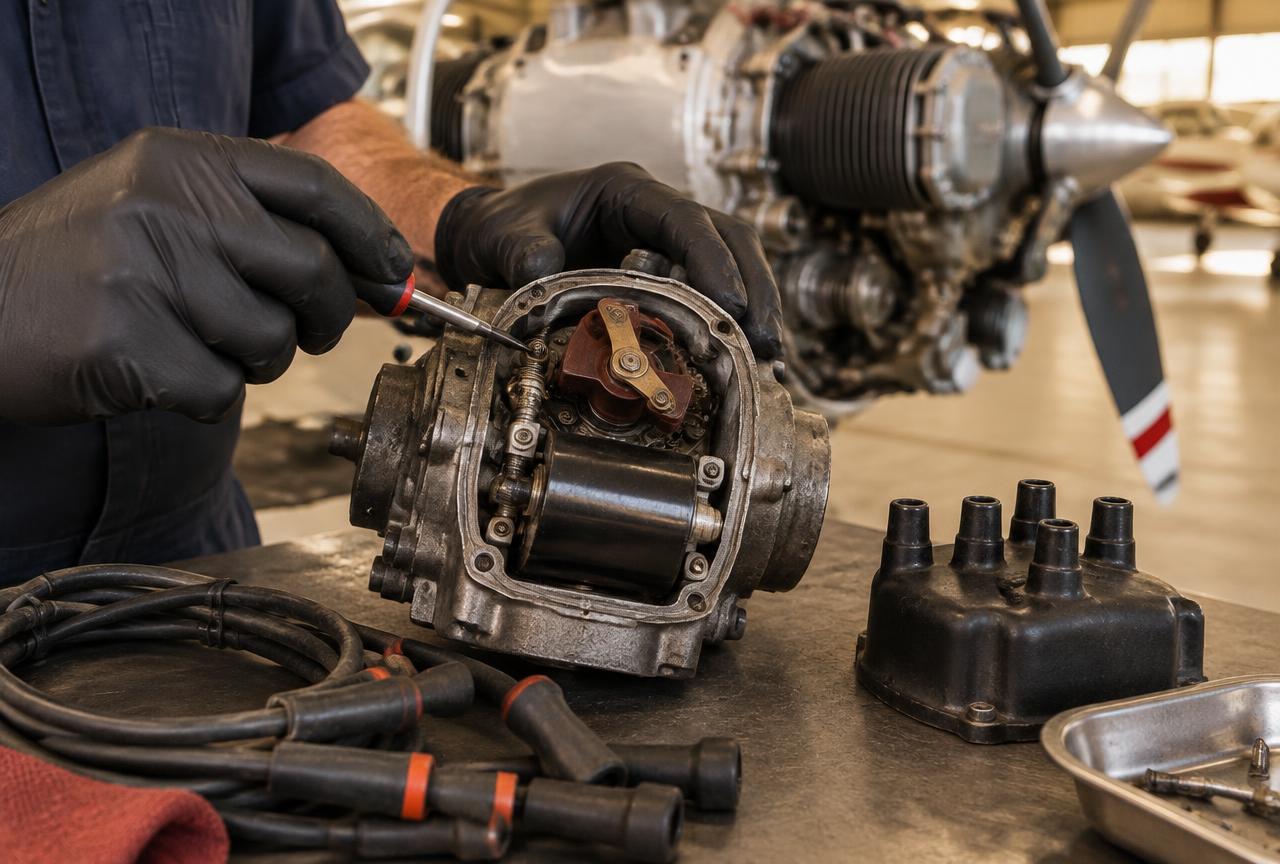
Your engine will keep running with a tired magneto — right up until it doesn't. Points erode, the coil insulation ages, carbon tracks form inside the distributor block, the impulse coupling pawls wear, and the internal timing drifts. None of that shows on a preflight. The 500-hour inspection exists because the manufacturers know exactly how long those parts last, and they wrote it down.
What the 500-hour inspection actually is
Both major ignition families call for a scheduled internal inspection at 500 hours of engine operation. Champion (Slick) publishes it in Service Bulletin SB1-15 and its maintenance manuals; Continental (formerly Bendix/TCM) publishes equivalent inspection requirements for the S-series and D-series magnetos in its service documents. The interval is stated in engine hours, not calendar time, and it is separate from the annual inspection — a low-use aircraft can go years without reaching it, while a busy trainer or rental can reach it twice in one year.
- The magneto is removed from the engine, opened, and inspected internally — this is not a visual check from the outside.
- Wear items are measured against the manual's limits and replaced when out of limits.
- Internal timing (E-gap) is verified and reset, then the magneto is re-timed to the engine after reinstallation.
- The impulse coupling, where fitted, is inspected for pawl and stop-pin wear — a common finding on training aircraft.
- The ignition harness and spark plug leads are checked, because a good magneto through a bad lead still misfires.
What goes wrong between inspections
- Contact points erode and the gap changes, which retards the spark and shifts internal timing.
- Carbon tracking inside the distributor block gives the spark an easier path than the plug — the classic cause of a cylinder that will not fire on one magneto.
- The coil's insulation ages with heat cycles and eventually breaks down, sometimes only when hot and under load.
- The rotating magnet loses strength slowly; output drops before it fails outright.
- The impulse coupling pawls wear and stop engaging, which shows up as hard starting long before anything else.
- The felt oiler dries out, the cam wears faster, and the whole sequence accelerates.
The warning signs a pilot can notice
Most magneto failures announce themselves. Write these down in the discrepancy log when they appear, with the date, hours, and conditions — the pattern is what the mechanic needs.
- 1A magneto drop on the ground check that is bigger than usual, uneven between magnetos, or accompanied by roughness that clears slowly.
- 2No drop at all on one magneto — often a grounding problem, and a hot-mag hazard around the propeller.
- 3Hard starting, especially on the impulse-coupled magneto side, or a start that needs an unusual amount of cranking.
- 4Roughness that appears at altitude, at high power, or once the engine is fully heat-soaked, but not on the ground.
- 5A single cylinder EGT that jumps during the magneto check, if you have an engine monitor — that is the cylinder losing one spark.
Planning it so it does not hurt
- Track engine hours, not calendar time, and set the reminder at least 25 hours before the interval so parts can be ordered.
- Combine it with the annual or a scheduled oil change when the hours line up — the cowling is already off and the labour overlaps.
- Decide in advance whether both magnetos go at once. Doing both keeps the intervals together and halves the removal labour later.
- Ask the shop about overhaul versus inspection: on a high-time magneto, an inspection that finds several out-of-limit parts can cost more than a planned overhaul or an exchange unit.
- Have the ignition harness and plug leads evaluated at the same time; they age on the same clock and they are the cheapest part of the job.
Keeping the record so it counts
An inspection you cannot prove is an inspection you will pay for twice — at the next annual, and again when you sell the aircraft. What matters is the entry in the maintenance record, made by the person who did the work, plus your own copies.
- The maintenance record entry: date, engine hours, what was done, part and serial numbers of each magneto, the reference document used, and the signature and certificate number of the mechanic.
- The shop invoice and any teardown or findings report, scanned and stored with the aircraft documents.
- The engine hours at the inspection, so the next 500-hour interval is calculated from a number you can defend.
- Photos of the magneto data plates, which is how you prove which unit is on which engine years later.
Frequently asked questions
Is the 500-hour magneto inspection required by the FAA?
Not by itself for most Part 91 owners. It is a manufacturer's scheduled inspection published in service documents. It becomes required when an airworthiness directive, an STC, or your operating rule makes the manufacturer's programme mandatory. Your mechanic decides how it applies to your aircraft.
Is it 500 hours on the engine or on the magneto?
The interval runs on the magneto's time in service, which normally matches engine hours since the magneto was installed, inspected, or overhauled. If a magneto was replaced with an exchange unit, its clock starts then — which is exactly why the part and serial numbers belong in the record.
Should I inspect both magnetos at the same time?
Most owners do, because the cowling and the removal labour are shared and the two intervals stay aligned. Your mechanic may recommend otherwise if the units have different times in service.
Inspection or overhaul — which is cheaper?
On a magneto near or past its overhaul time, the inspection often uncovers enough out-of-limit parts that a planned overhaul or an exchange unit costs less overall. Ask the shop for both quotes before authorising the work.
My magneto drop is fine. Can I skip it?
A normal ground check tells you the magneto fires now; it says nothing about points erosion, carbon tracking, or coil insulation that fails when hot. That is the whole reason the inspection is internal and scheduled by hours.
More guides
Keep every due date in one place
Volamus tracks inspections, documents, discrepancies and costs for each aircraft and reminds you before anything lapses.