
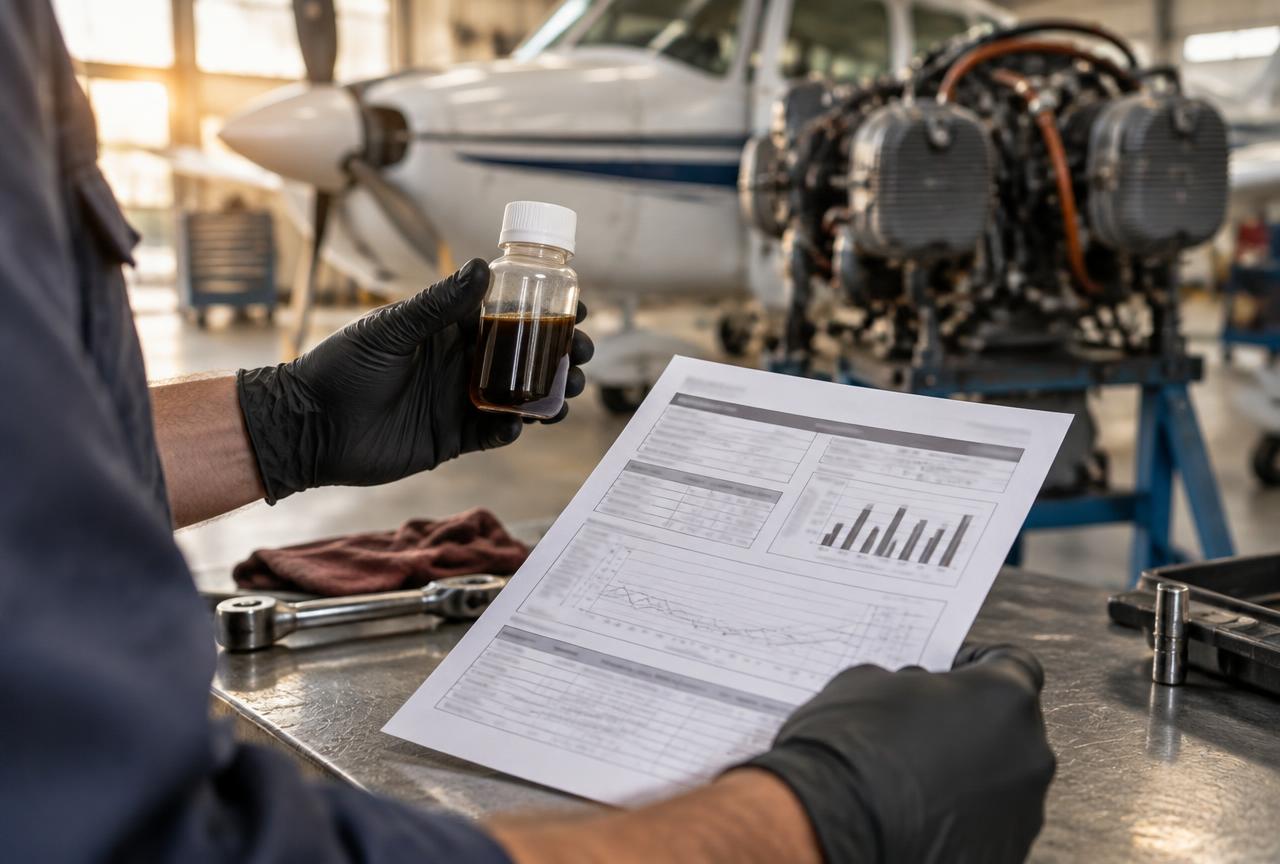
An engine does not tell you it is wearing out. It wears for hundreds of hours in silence, and then it tells you once — at cruise, with a rough-running cylinder or an oil loss nobody can explain. Oil analysis exists to break that silence. A small bottle of used oil carries a measurable record of what is leaving your engine's internal surfaces, and it costs less than an hour of flying.
What the lab is actually measuring
A routine oil analysis report is four separate measurements on the same sample. Read them as four different questions, because a number that looks alarming in one column is often perfectly normal in another.
- Wear metals — iron, chromium, aluminium, copper, tin, nickel and lead. These come from the surfaces meant to slide past each other: cylinder walls, piston rings, crank and cam journals, bearings, gear trains.
- Contaminants — fuel, water, glycol from a coolant path, and silicon from dust or an air-filter problem. Each one points at a different failure mode.
- Additives — magnesium, calcium, boron, potassium, sodium. When they fall, the oil is exhausted or diluted and has stopped protecting the engine it was supposed to protect.
- Oil condition — viscosity, oxidation, nitration and soot. This says whether the oil is still inside the range the engine was designed for, and whether the change interval you are running is too long.
The findings that actually change plans
- 1One metal climbing steadily across three or four samples. A single high number is often a sampling fluke. A consistent climb is a mechanism, and a mechanism is what your mechanic will want to investigate — usually with a borescope and a compression test before anything is disturbed.
- 2Fuel dilution. Petroleum in the oil thins it and lowers its flash point. Frequent short trips and rich running do that; a leaking injector or a stuck needle does it too. The fix and the urgency are not the same in those two cases.
- 3Water or glycol. A trace of water can be condensation from short flights. Water with glycol, or glycol on its own, points toward a coolant path into the engine — that is serious and deserves a professional evaluation before the next flight.
Sampling so the report is worth reading
Most disappointing reports are sampling problems, not engine problems. The bottle is small and the lab's limits are tight, so the routine matters more than people expect.
- Draw the sample while the oil is warm, at the oil change, from the drain stream — the middle of the flow, not the first flush and not the last dregs.
- Fill to the line and cap it immediately. An overfilled or an open bottle changes the result.
- Label it with tail number, engine, hours at sampling and date.
- Keep the same lab, the same oil brand and grade, and the same filter across the whole history. Changing any of them resets your comparison.
- Keep the interval honest. Sampling at every oil change is the standard advice; if you sample every other change, do it consistently and accept that a fast-moving problem can hide in the gap.
- Do not add an additive or a top-up product before a sample. You are measuring the oil, and you have just changed it.
What oil analysis will not tell you
- It will not tell you the engine is airworthy, or that the aircraft is fit to fly. Nobody can say that from a lab report.
- It will not find a cracked cylinder head, a leaking valve stem seal or a loose intake manifold — some of those never reach the oil in measurable amounts.
- It will not replace a compression test or a borescope. It says something may be happening; those two say where.
- It will not catch a problem that starts the day after your sample. It is a rhythm, not a live feed.
- It will not detect anything that never touches the oil — a tired magneto, a fouled plug, a worn tire.
Doing it on a tight budget
- Sample at the oil change you already pay for. The extra cost is the kit and the shipping.
- If you only do one thing, sample every time for the first three changes so you build a baseline. Three readings from the same routine tell you more than ten readings from three different habits.
- Keep the PDFs. Their value is not in one report, it is in what you can compare against in two years — and in what a buyer will ask to see.
Keeping the record so it counts
A report you cannot find is a report you never ran. Keep the file with the aircraft, not in a mailbox.
- The lab PDF, named with the date and the engine hours at sampling.
- The oil brand, grade and filter used, and the change interval you are running.
- Anything out of the ordinary: a repair, an additive, a long stretch of ground running, a change of fuel supplier.
- The hours and the date, so the next sample comes from the same clock.
Frequently asked questions
How often should I send an oil sample?
At every oil change is the standard advice and the safest answer. If you fly very little, one or two samples a year still build a history, but understand that the gap can hide a fast-moving problem. Whatever you choose, keep the interval consistent — a trend needs evenly spaced points.
Do I have to keep using the same lab?
Strongly recommended. Labs differ in methods, in the reference ranges they publish and in the engine-type averages they compare you against. Switching labs breaks your trend line even if the engine has not changed.
The report flagged something. Is my engine failing?
Not necessarily. A single flag can come from sampling technique, a recent repair, break-in wear or a short-flight routine. What matters is whether the same element keeps climbing across several samples. Send the report to your mechanic and let them put it in context.
Can I change oil brands if I send samples?
You can, but expect the comparison to reset. Additive packages differ, so calcium, boron and magnesium will move when you switch. Note the change in your log and give the new oil two samples before reading much into it.
Is oil analysis a substitute for a compression check or a borescope?
No. Oil analysis is a wide, slow look at what the engine is shedding. A compression test and a borescope examine a specific cylinder right now. Owners who act on oil analysis usually end up doing one of those two — the report says something is worth a look, not what it is or how serious it is.
More guides
Keep every due date in one place
Volamus tracks inspections, documents, discrepancies and costs for each aircraft and reminds you before anything lapses.