
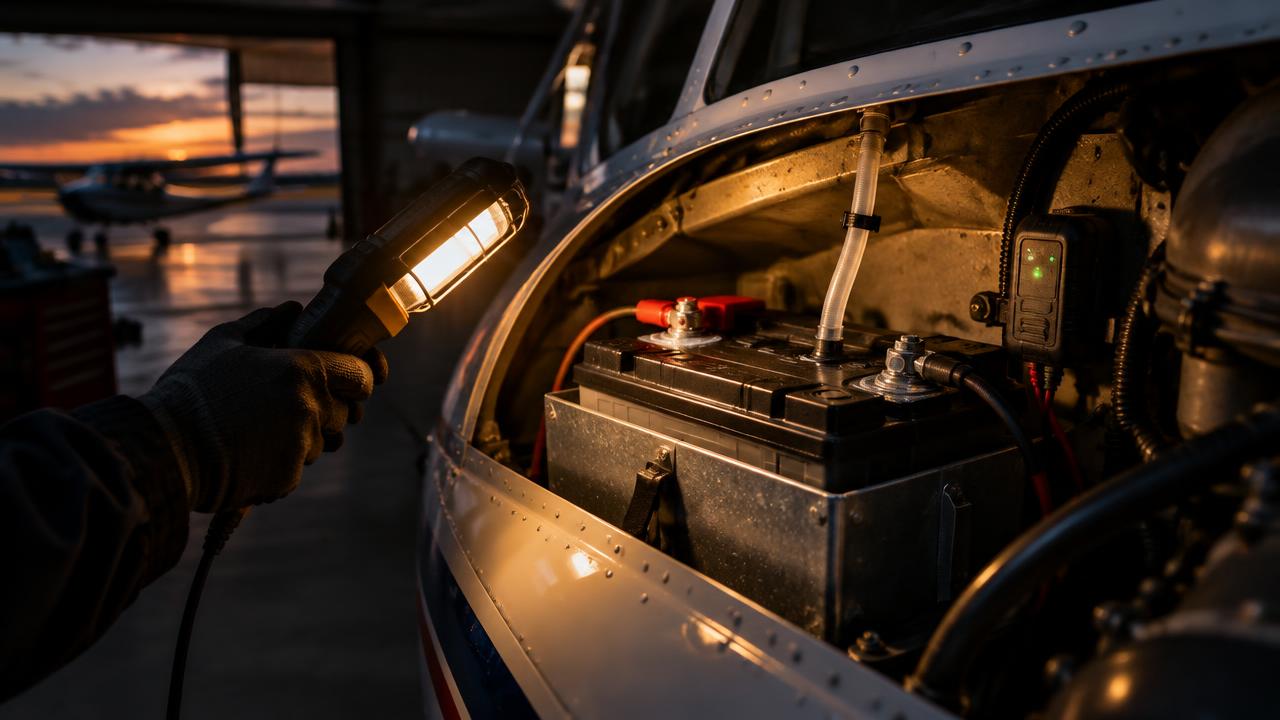
The battery is the only part of the aircraft that keeps working after everything else is shut down, and the only part that slowly dies while the aircraft simply sits. A battery that spends its life half discharged ages in silence: plates sulphate, capacity shrinks, and one cold morning the engine cranks like a tired machine instead of a fresh one. The habits that keep a battery alive are small; the test that measures what is left of it is not something to improvise in a garage.
What an owner may do, and what has to be logged
In the United States, Appendix A to Part 43 places battery servicing — replacement and the routine care around it — within the preventive maintenance an owner or pilot may perform, as long as the work stays at the level the manufacturer's instructions describe and nothing beyond it is required. Cleaning terminals, topping up a wet-cell battery with distilled water, charging with a suitable charger, swapping a battery for the approved part number: these are owner tasks. Anything that involves opening the electrical system beyond that — corroded cables, a master solenoid, a wiring fault behind the charging problem — is a certificated mechanic's work.
Whatever is done, and whoever does it, the work has to be recorded: date, aircraft hours, what was done, the part numbers used, and the name of the person who did it. A battery replacement that never reached the logbook is a gap the next annual inspection — and the next buyer — will ask about.
The habits that keep a battery alive
- Never store a battery discharged. A lead-acid battery left flat sulphates within weeks, and part of that lost capacity never comes back. Charge it soon after the flight, not at the end of the month.
- Use the right charger. A small aviation or motorcycle-type smart charger that holds a float voltage is right. An unattended automotive charger can cook a battery overnight.
- On wet-cell batteries, check electrolyte level and top up with distilled water only — after charging, not before, and never above the plates.
- Keep terminals and connectors clean, tight and lightly coated with the protectant the manufacturer approves. A green, fuzzy terminal adds resistance exactly where the starter needs it least.
- Confirm the battery is secure, the vent line is clear and the box is dry. A battery that moves in its box cracks its own case.
- Watch the calendar: wet-cell batteries carry an expiry date, and a battery that sat on a shelf for two years before it was installed is not a new battery.
- Long idle does not charge a battery. The alternator's output at idle is modest, and taxiing, run-ups and short flights may leave the battery net negative for the day.
- In cold weather, capacity drops sharply. A battery that is marginal in October becomes a no-start in January; a warm hangar or a maintainer plugged in over the winter is cheaper than a dead morning.
What the capacity check actually measures
A capacity check is a controlled discharge. The battery is fully charged, then discharged at a fixed current for a fixed time — or down to a set cut-off voltage — and the energy it delivered is compared with the rated capacity of the battery. The result is a percentage: how much of the battery's rated capacity it can still actually supply. Manufacturers and inspectors commonly treat a battery that delivers less than 80 percent of its rated capacity as failed, but the exact criterion and the exact procedure belong to the battery and aircraft manufacturer's instructions, and those are what the mechanic follows.
The test needs equipment a hangar does not usually own: a calibrated discharge load, instruments that read current and voltage accurately, temperature control and the patience to run the discharge all the way through and then recharge the battery promptly. It is shop work, usually done by a certificated mechanic or a battery shop, often during annual inspections or when a battery has a history. A voltage reading from a hand multimeter is not a capacity check — a battery can read 12.7 volts on the surface and still deliver a third of its rated amp-hours.
Signs the battery is near the end
- Slow cranking on a battery that was fully charged the night before.
- A battery that needs water constantly, or one that gasses more than it used to.
- A bulging, cracked or distorted case, or white crust around the terminals.
- A battery that will not hold charge overnight, or that a charger shows full yet the aircraft disagrees with.
- Avionics or starter behaviour that the charging system check cannot explain — sometimes the problem upstream of the battery is the regulator, which is mechanic's work.
- Repeated jumps or repeated external charges in the same month. A battery that needed two rescues is telling you its capacity is gone.
The routine fits in one line: charge after flying, top up with distilled water, keep the terminals clean and tight, keep it secure and ventilated, respect the dates, and let a proper capacity check — not a multimeter — decide when it is finished. Do that and the battery will be boring, which is exactly what you want from it.
Frequently asked questions
Can I replace the aircraft battery myself?
In the United States, battery servicing and replacement sit within the preventive maintenance of Appendix A to Part 43 that an owner may perform, following the manufacturer's instructions and logging the work. Aircraft used in commercial or instructional operations can carry stricter rules, and anything beyond the simple swap is a mechanic's work.
How often should a capacity check be done?
There is no single universal interval: the battery manufacturer's instructions and the aircraft's maintenance programme govern, and for many batteries the check happens at annual inspection, after a suspected deep discharge, or whenever the battery's behaviour raises doubt. Follow the manufacturer's guidance for your specific battery rather than a rumoured rule of thumb.
Can I use a car battery charger?
An unattended automotive charger can overcharge and cook an aircraft battery quickly. Use a smart charger or maintainer that holds a proper float voltage, rated for the battery's size, and never leave a crude charger connected overnight.
My battery reads 12.6 volts. Isn't that a good battery?
Surface voltage says the battery is charged, not that it has capacity left. A sulphated battery can read full voltage and deliver a fraction of its rated amp-hours under load. Only a controlled discharge test measures what it can actually supply.
The engine cranks slow but the battery is new. What now?
Then the problem is probably not the battery: corroded cables, a tired starter, a poor ground path, or a charging system that never fully recharges the battery. That diagnosis belongs to your certificated mechanic, and chasing it with more batteries gets expensive.
How should the aircraft be left for a month or more?
Charge the battery fully before storage, connect an approved maintainer if power is available, or disconnect the battery if the aircraft's instructions allow it — and expect to top up a wet-cell and re-charge before the first flight after storage. Log what you did; the next inspection will want to see it.
More guides
Keep every due date in one place
VolamusApp tracks inspections, documents, discrepancies and costs for each aircraft and reminds you before anything lapses.